
Xiangqi
A two-player strategy game from China, related to Western chess.

Yevrowl · CC BY-SA 4.0
Xiangqi, commonly known in the West as Chinese chess, is a strategy board game for two players and the most popular board game in China. It belongs to the same family of games as shogi, janggi, Western chess, chaturanga, and Indian chess, and is also a popular pastime in Vietnam, where it is called cờ tướng.
- field
- Strategy board game
- known_for
- Most popular board game in China; distinctive features include the cannon, the river, the palace, and the flying general rule
- origin
- China
- also_played_in
- Vietnam (as cờ tướng)
Lore & Background
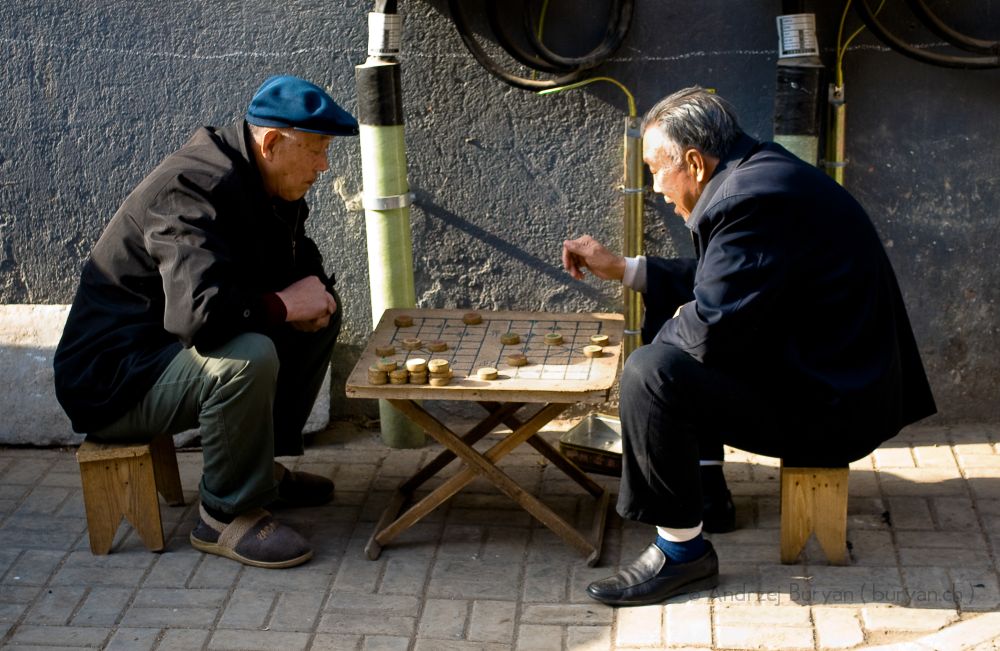
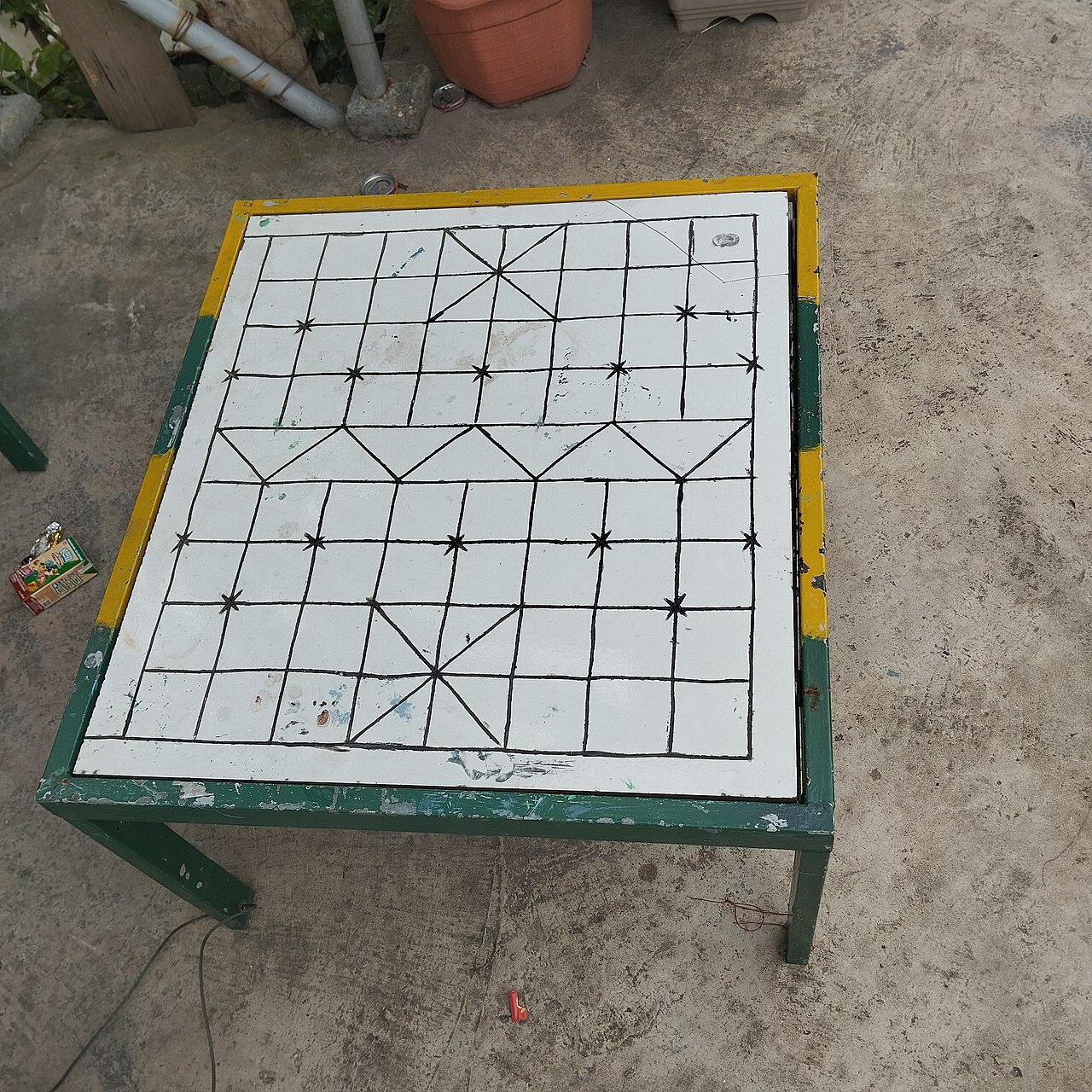
Xiangqi is played on a board nine lines wide and ten lines long, with pieces placed on intersections. The board features a river dividing the two sides, marked with phrases referencing the Chu–Han War, and two palaces, each three points by three points, demarcated by diagonal lines. Historically, the board was often a lined sheet of paper, but wooden or plastic boards are now common.
Reader's Guide
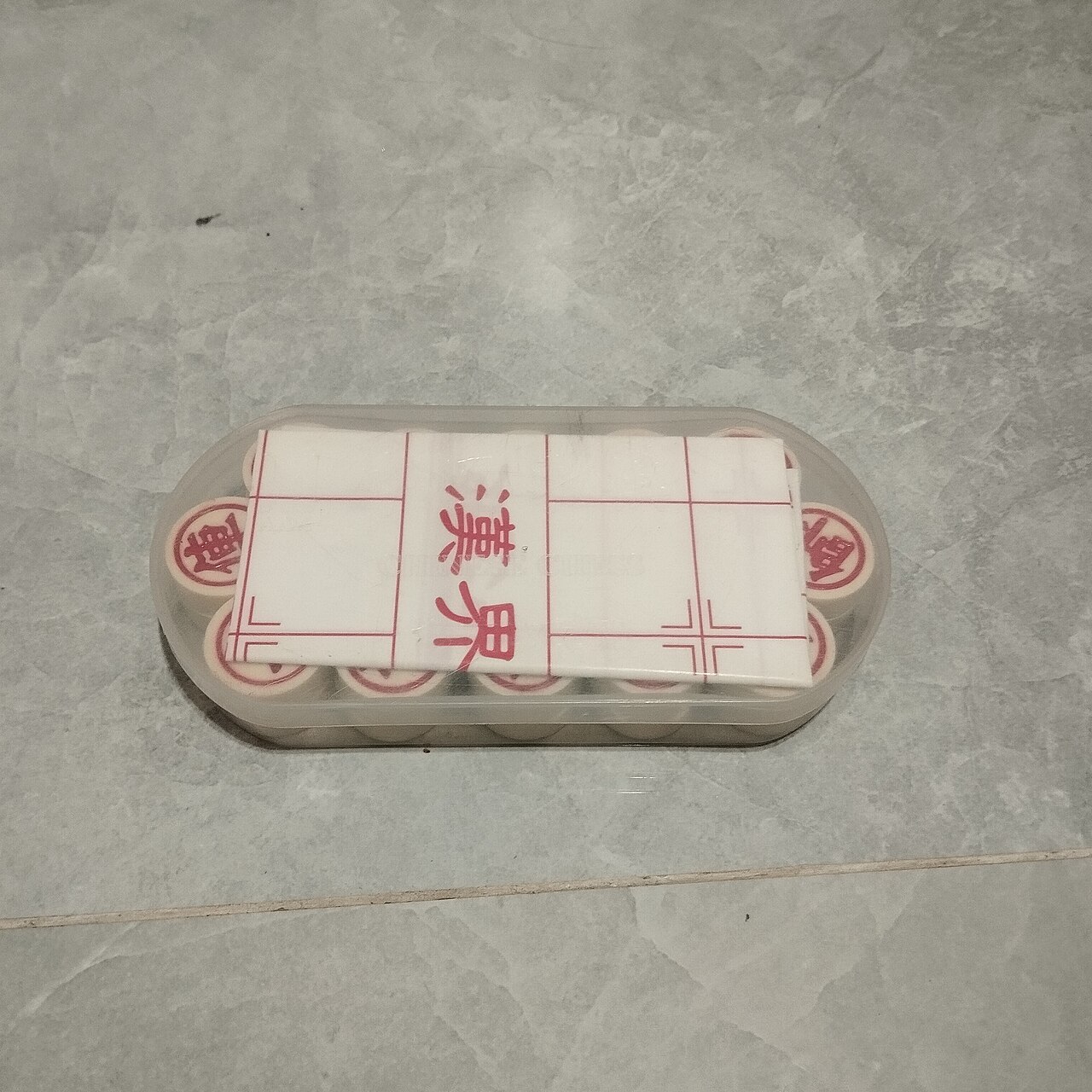
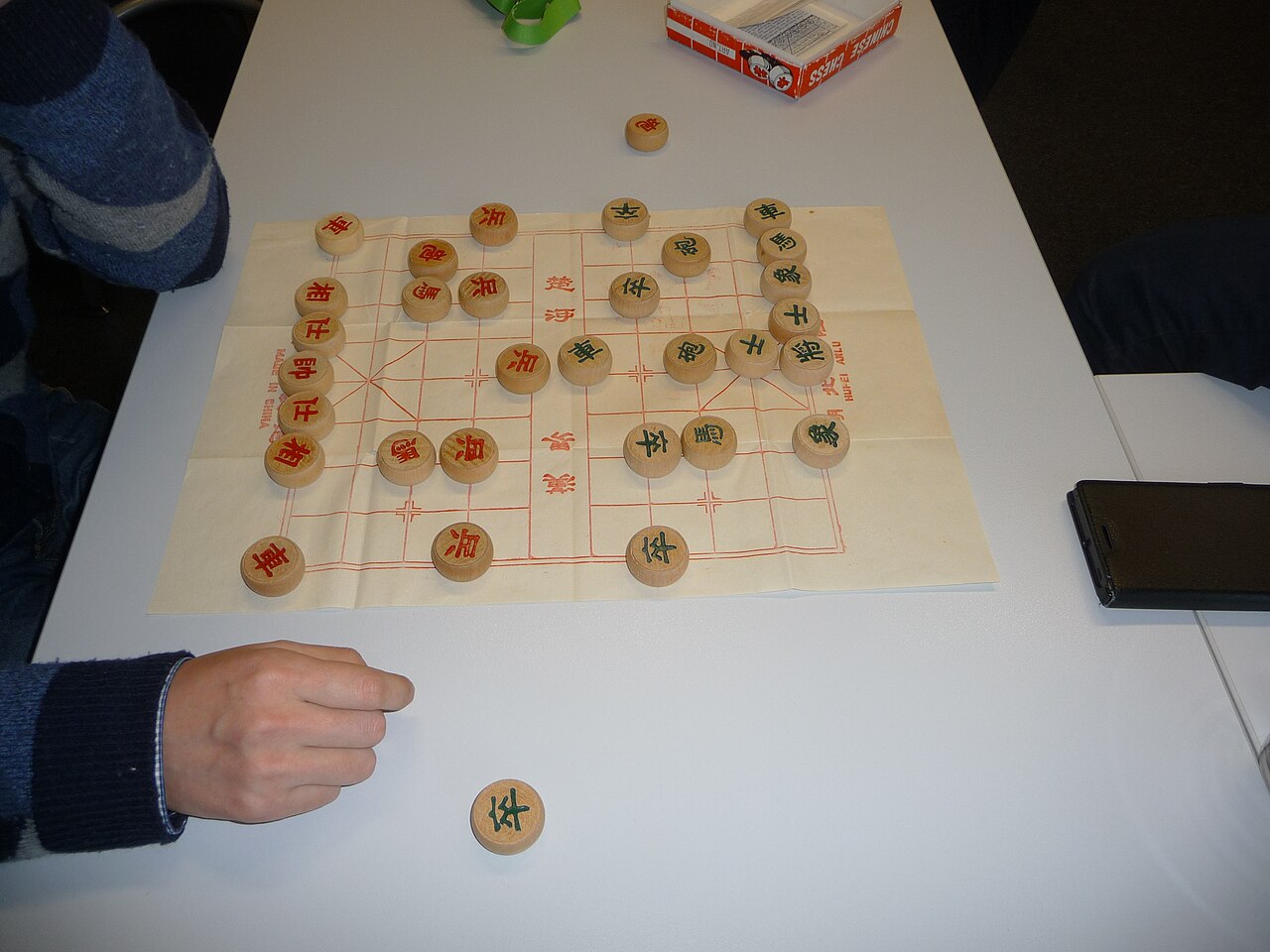
Each player controls an army of 16 pieces, flat circular disks labeled with Chinese characters. The opposing sides are distinguished by ink color, usually red and black, and sometimes by using different characters for the same piece type. The general (or king) starts at the midpoint of the back edge within the palace and may move one point orthogonally, but cannot leave the palace except via the flying general move, which captures the enemy general if they face each other on the same file with no intervening pieces. Advisors move one point diagonally and are confined to the palace. Elephants move two points diagonally, cannot jump, and are blocked by an adjacent piece; they also cannot cross the river. Horses move one point orthogonally then one point diagonally away, and can be blocked by a piece adjacent to them. Chariots move any number of points orthogonally. The cannon must jump to capture. Soldiers have an enhanced move after crossing the river. The game's name, xiangqi, is generally interpreted as 'elephant chess,' though H. J. R. Murray offered alternative interpretations including 'the Figure Game,' which he considered the probable true meaning.
Did You Know?
- The oldest xiangqi piece found to date is a chariot piece, kept in the Three Gorges Museum.
- The river on the board is often marked with the phrases 'River of the Chu' and 'Border of the Han,' referencing the Chu–Han War.
- The general piece was originally called 'king' but was renamed due to Chinese naming taboos against using royal titles for game pieces.
- The cannon (pao) must jump to capture, a distinctive feature not found in Western chess.
The Name and Its Layers of Meaning
The name xiangqi carries multiple possible interpretations that reveal the game's layered history. The character xiàng can mean elephant, ivory, a carved figure, or even a celestial phenomenon. H. J. R. Murray proposed four readings—Elephant Game, Ivory Game, Astronomical Game, and Figure Game—and argued the last was most likely the original intent, suggesting the game once used sculpted pieces rather than the flat disks we see today. The second character, qí, is a broad term for board games that also appears in weiqi and fangqi. In Vietnam, the game is called cờ tướng, "General's chess," deliberately set apart from cờ vua, "King's chess," the Western game. This naming distinction mirrors a broader cultural sensitivity: within China, the royal title "king" was replaced by "general" or "marshal" because rulers objected to their own titles being assigned to game pieces. Yet English-speaking players still often call the piece a king, blurring the line between the two traditions.
A Board Shaped by History
The xiangqi board is a grid of nine vertical lines called files and ten horizontal lines called ranks, with pieces placed on the intersections rather than inside squares—a design shared with Go. Two three-by-three zones, the palaces, sit at the top and bottom, marked by diagonal lines crossing at their centers. Between them, the river divides the two armies. The river bears the inscriptions "River of the Chu" and "Border of the Han," a direct nod to the ancient Chu-Han War. Yet this dramatic visual split has surprisingly limited mechanical impact: only soldiers gain an extra move after crossing it, and elephants are barred from crossing entirely. Historically, the board was often just a sheet of paper, used once and discarded, though wooden and plastic versions are now standard. The starting positions for soldiers and cannons are sometimes marked with small crosses, a subtle aid for new players navigating the 90-point playing surface.
Pieces, Rules, and the Flying General
Each side commands sixteen flat, circular pieces engraved with a single Chinese character, typically in red and black ink, though blue, green, or white inks also appear. The pieces are distinguished not just by color but sometimes by using entirely different characters for the same piece type on each side—a practice that may trace back to an era when only unpainted woodcarvings were available. The general, confined to the five points of the palace, moves one step orthogonally. The most unusual rule involves the "flying general": if both generals share a file with nothing between them, the moving general may leap across the board to capture. In practice, this simply means a player has moved into check. The cannon, which must jump exactly one piece to capture, and the advisor, restricted to diagonal steps within the palace, are mechanics with no direct Western chess equivalent. The oldest surviving xiangqi piece, a chariot, is held in the Three Gorges Museum.
A Shared Ancestry Across Asia
Xiangqi belongs to a broad family of strategy games that includes shogi in Japan, janggi in Korea, and the Western chess tradition, all tracing lineage back to chaturanga and Indian chess. This shared ancestry is visible in specific pieces: the advisor is likely a descendant of the mantri from chaturanga, the same ancestor that evolved into the queen in Western chess. The game's popularity extends well beyond China; in Vietnam it is a beloved pastime, known as cờ tướng. In mainland China, it remains the most widely played board game, and even modern sets there tend to use traditional rather than simplified characters for the piece labels. Materials range from inexpensive plastic to wood, horn, bone, ivory, and jade for premium sets. The game's position as a cultural touchstone—distinguished from Western chess by its river, its palace, its jumping cannon, and its intersection-based placement—makes it a window into a distinct strategic tradition that has evolved in parallel with, but independently from, the chess played in Europe.
Common Misconceptions (Editorial)
Some people mistakenly believe xiangqi is identical to Western chess, but it has unique features like the cannon (pao), which must jump to capture, and a river dividing the board that Western chess lacks. Another common misconception is that the general piece has always been called “general”; in fact, it was originally named “king” but was renamed due to Chinese naming taboos against using royal titles for game pieces.
Why It Matters (Editorial)
Xiangqi endures because it is not just a game but a living link to Chinese history, with its board layout referencing the Chu–Han War and its pieces reflecting ancient military roles. Its continued popularity across China and Vietnam shows how a simple strategy game can transcend centuries, offering both intellectual challenge and cultural connection.
Gallery


Frequently Asked Questions
What is Xiangqi?
Xiangqi is a two-player strategy board game that originated in China and is widely considered the country's most beloved board game. In the West it is most often called "Chinese chess."
How does Xiangqi differ from Western chess?
Xiangqi introduces several mechanics absent from Western chess: a cannon that captures by leaping over a piece, a central river splitting the board, a palace that limits the general's movement, and the flying-general rule that bars the two generals from sharing an open file.
Where did Xiangqi come from and where else is it played?
The game traces its roots to China and sits within the same family of chess-like games as shogi, janggi, chaturanga, and Western chess. It is also a popular pastime in Vietnam, where it is known as cờ tướng.
What are the distinctive features of Xiangqi?
The cannon, the river, the palace, and the flying-general rule together give Xiangqi a tactical character that sets it apart from its Western cousin. These elements shape nearly every strategic decision a player makes.
Why is Xiangqi important in board-game history?
As the most popular strategy board game in China, Xiangqi represents one of the major surviving branches of the ancient chess-like game family. Its centuries-long cultural presence and widespread play make it a cornerstone of the broader chess tradition.
More in Board Games 1-22
Spotted an error? Know more?
This is a living reference — every entry is fact-audited, and reader corrections feed straight into our audit queue. Suggest an edit · See this site's audit record