Risk
A board game of global conquest and diplomacy.

Document02 · CC0
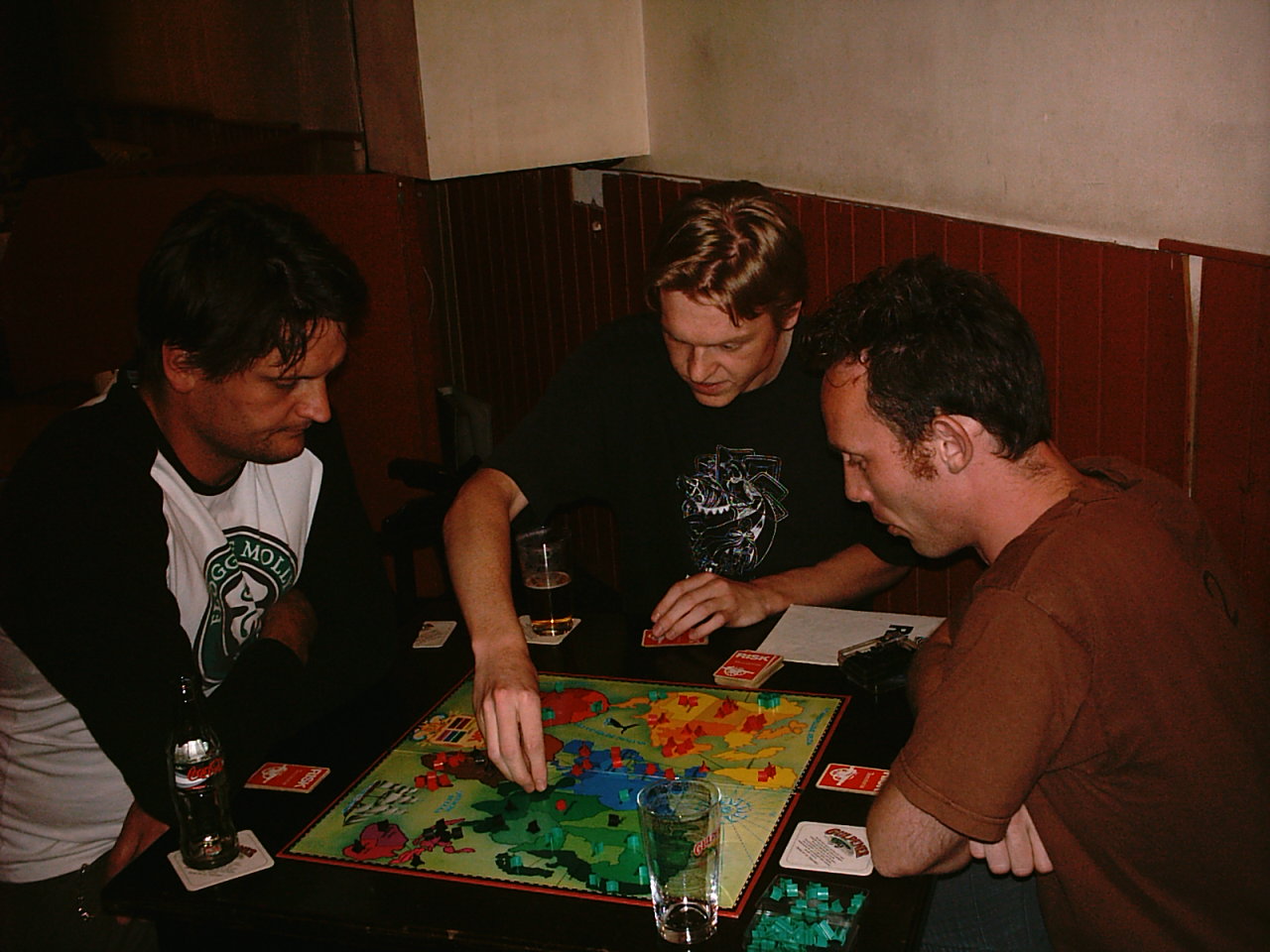
Risk is a strategy board game of diplomacy, conflict and conquest for two to six players. It is still in production by Hasbro with numerous editions and variants.
- inventor
- Albert Lamorisse
- original_name
- La Conquête du Monde (The Conquest of the World)
- publisher
- Parker Brothers (later Hasbro)
- genre
- Strategy board game
- players
- 2 to 6
Reader's Guide
Risk's significance lies in its enduring popularity and influence on the board game industry. It introduced a blend of strategy, diplomacy, and luck through dice rolls, set in a world-conquest theme that has been replicated and adapted in numerous other games, including Axis & Allies and Settlers of Catan. The game's core mechanics—territory control, reinforcement, and alliance formation—have become staples in the strategy genre. Over decades, Risk has evolved through many editions, from the original wooden cubes to plastic infantry, cavalry, and artillery tokens, and from classic world maps to futuristic and media-themed variants. Its ability to be adapted to different rules, such as secret missions that shorten gameplay, and its presence across PC software, video games, and mobile apps, demonstrate its lasting appeal. The game remains in production by Hasbro, with new themes and editions continuing to be introduced, cementing its legacy as a foundational title in modern board gaming.
Did You Know?
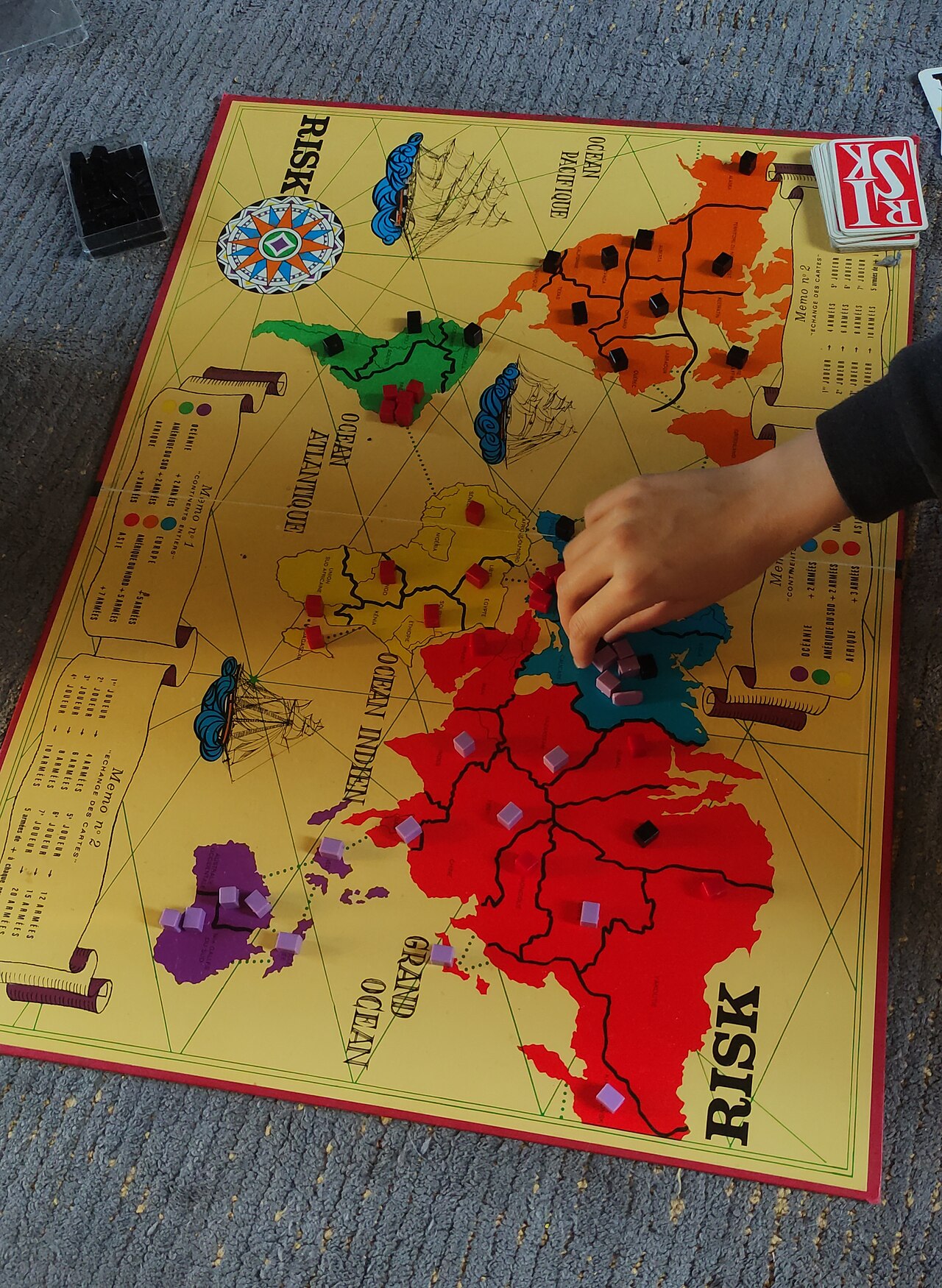
- The standard version is played on a board depicting a political map of the world divided into 42 territories grouped into six continents.
Origins & Evolution
Risk traces its roots to 1957, when French film director Albert Lamorisse created a board game he called La Conquête du Monde, meaning The Conquest of the World. The title itself speaks to the game's core ambition: total territorial domination. Parker Brothers acquired the property and brought it to a wider audience in 1959 under the name Risk: The Continental Game, making rule adjustments along the way. A decade later, in 1975, Parker Brothers updated the branding to Risk: The Game of Global Domination, a title that better captured the sweeping, world-scale nature of the conflict. When Hasbro absorbed the Parker Brothers brand in 1991, the game eventually migrated under the Hasbro Gaming umbrella. Across nearly seven decades, Risk has maintained its place as one of the most widely recognized and played board games ever produced, a testament to the enduring appeal of its simple premise: roll dice, capture land, and outmaneuver your opponents on a map of the entire world.
Game Mechanics & Equipment
At the heart of every Risk set lies a large tabletop board rendering a political map of the world, split into forty-two territories organized into six color-coded continents. These territories are linked by shared borders and, in the most recent edition, eighty-three attack routes, including special trans-oceanic paths such as the one connecting North Africa to Brazil. Players command armies represented by colored tokens, with a few larger pieces standing in for five or ten troops to simplify tracking. The game also includes a deck of forty-two territory cards, two wild cards bearing all three unit symbols, and mission cards for the Secret Mission variant. Matching card sets can be traded in for reinforcements at the start of a turn, with a Golden Cavalry piece tracking the escalating reward value. Combat is resolved with three red dice for the attacker and two or three white or blue dice for the defender. Over the decades, the physical tokens have shifted from wooden cubes to molded plastic, to Roman-numeral shapes, to infantry-cavalry-artillery tokens, and even to metal in a 40th-anniversary edition, before returning to wooden cubes in the 2005 bookcase release.
Variants & Themed Editions
Since its debut, Risk has spawned a remarkable catalogue of spin-offs and themed reimaginings. In 1986, Castle Risk swapped the world map for a board depicting eighteenth-century European castles, though it proved a financial disappointment. The Secret Mission rules, long standard in European editions, were finally folded into the United States version in 1993, giving each player a limited personal objective that shortened what could otherwise be a game stretching from several hours to multiple days. A commemorative Risk: Édition Napoléon appeared in France in 1999 to mark the bicentennial of the Napoleonic era. In 2001, Hasbro's Avalon Hill division released Risk: 2210 A.D., a futuristic edition featuring moon and ocean territories, commander units, and several expansions. From 2002 onward, media-franchise editions tied to The Lord of the Rings, Star Wars, and Transformers hit shelves, sometimes as many as six per year. In 2008, Winning Moves, a Hasbro licensee, issued 1959 Risk, a faithful reproduction of the original Parker Brothers box with its original artwork, wooden pieces, and rules. The 2022 rebrand of the iconic Risk logo, handled by Toronto-based agency Quake, signaled the brand's continued evolution.
Legacy & Cultural Impact
Few board games have left as broad a fingerprint on the hobby as Risk. Its blend of diplomacy, conflict, and conquest for two to six players established a template that directly inspired later titles such as Axis & Allies and Settlers of Catan, both of which carry forward the spirit of strategic territorial competition. The core loop—build an army, roll dice to seize territory, form and dissolve alliances turn by turn—remains instantly recognizable and endlessly replayable. The victory condition, occupying every territory on the board and eliminating all opponents, is deceptively simple yet generates hours or even days of shifting loyalties and betrayals around the table. Hasbro continues to produce the game in numerous editions and variants, extending its reach into PC software, video games, and mobile apps. In 2022, the Risk logo itself was refreshed by Toronto-based creative agency Quake, a reminder that a title first printed in 1957 still commands a global audience eager to conquer the world, one territory at a time.
Common Misconceptions (Editorial)
Some might assume Risk was first published by Hasbro, but it was originally published by Parker Brothers. Others might think the game was originally created in English under its current name, but its original name was La Conquête du Monde (The Conquest of the World), invented by Albert Lamorisse.
Why It Matters (Editorial)
Risk endures because it combines strategic depth with the unpredictable drama of human interaction, making each playthrough a unique story of alliances and betrayals. Its simple mechanics belie the complex geopolitical thinking it demands, which is why it remains a staple of game nights more than six decades after its creation.
Gallery

Frequently Asked Questions
How many players can Risk accommodate?
The game supports anywhere from two to six players, making it flexible for both small head-to-head matches and larger group sessions.
What is Risk actually about?
Risk is a strategy board game centered on global conquest, where players recruit armies, negotiate alliances, and launch attacks to claim territories on a world map. Victory comes through diplomacy as much as military force.
What was Risk's original French name?
Before it became known as Risk, the game was called La Conquête du Monde, meaning 'The Conquest of the World.' The shorter English title was adopted when Parker Brothers brought it to international markets.
Why is Risk considered important in board game history?
As one of the best-selling board games ever produced, Risk set the template for the strategy genre and directly inspired titles like Axis & Allies and Settlers of Catan. Hasbro continues to release new editions and variants, keeping the game in active production decades after its debut.
More in Board Games 1-22
Spotted an error? Know more?
This is a living reference — every entry is fact-audited, and reader corrections feed straight into our audit queue. Suggest an edit · See this site's audit record