Catan
A Eurogame of settlement building and resource trading on Catan.

Elebls · CC BY-SA 4.0
Catan, previously known as The Settlers of Catan or simply Settlers, is a multiplayer board game designed by Klaus Teuber. First published in 1995 in Germany by Franckh-Kosmos Verlag (Kosmos), it became one of the first Eurogames to achieve popularity outside Europe. As of 2020, more than 32 million boxed sets in 40 languages had been sold.
- Designer
- Klaus Teuber
- First published
- 1995
- Publisher
- Franckh-Kosmos Verlag (Kosmos)
- Genre
- Eurogame
- Players
- 3–4 (expandable to 6)
- Languages
- 40
- Copies sold
- Over 32 million (as of 2020)
Lore & Background
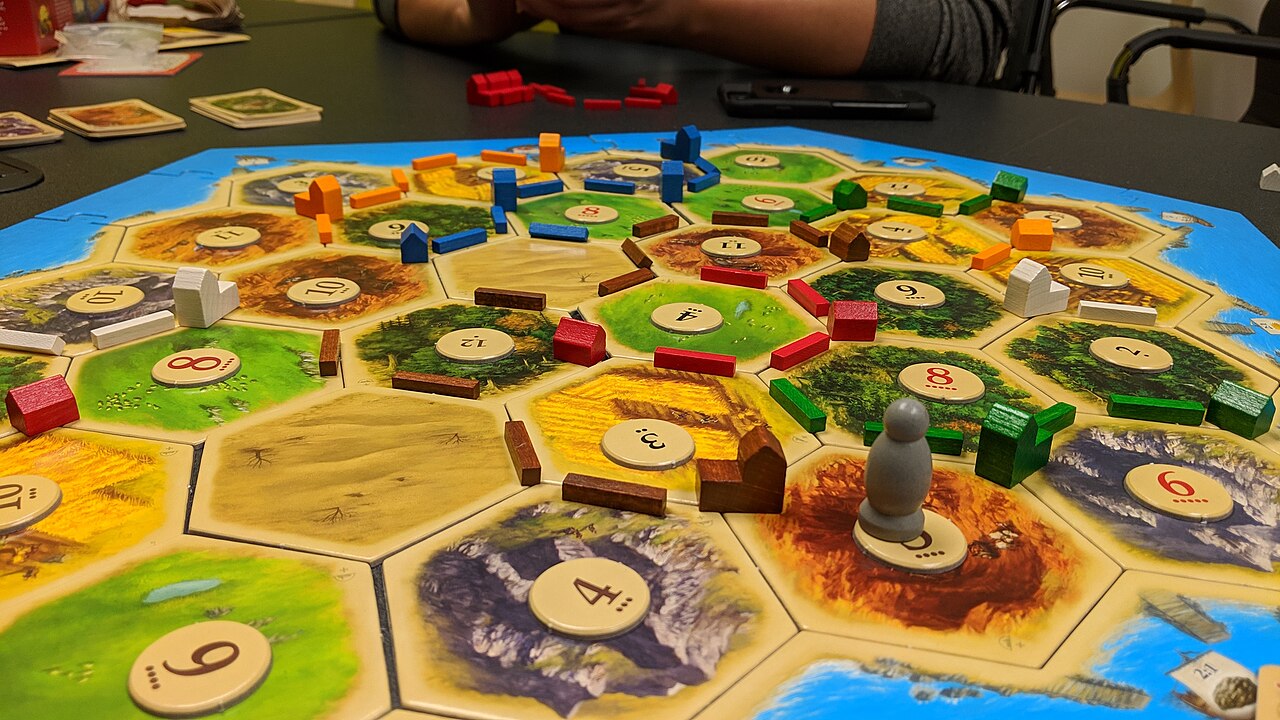
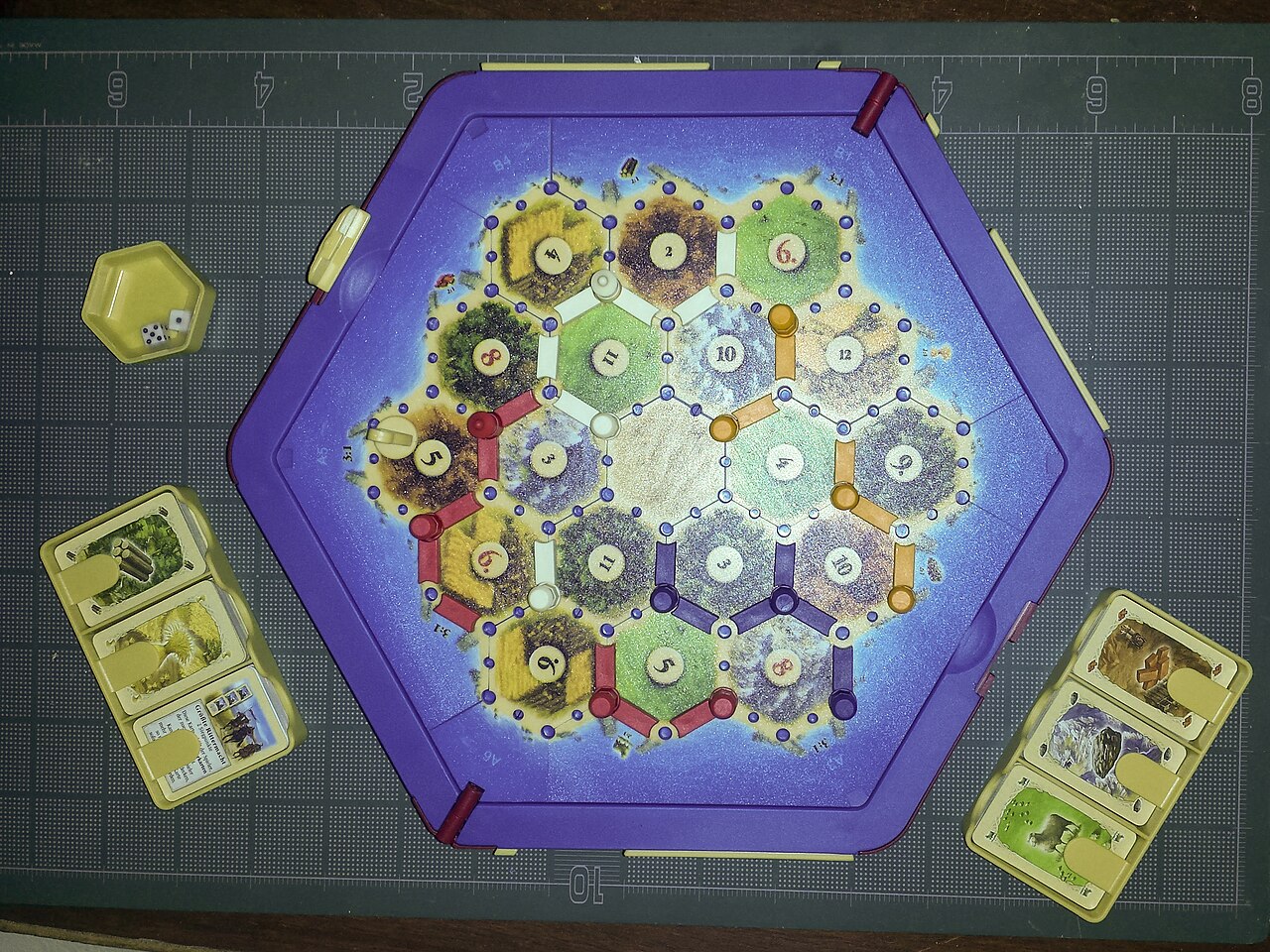
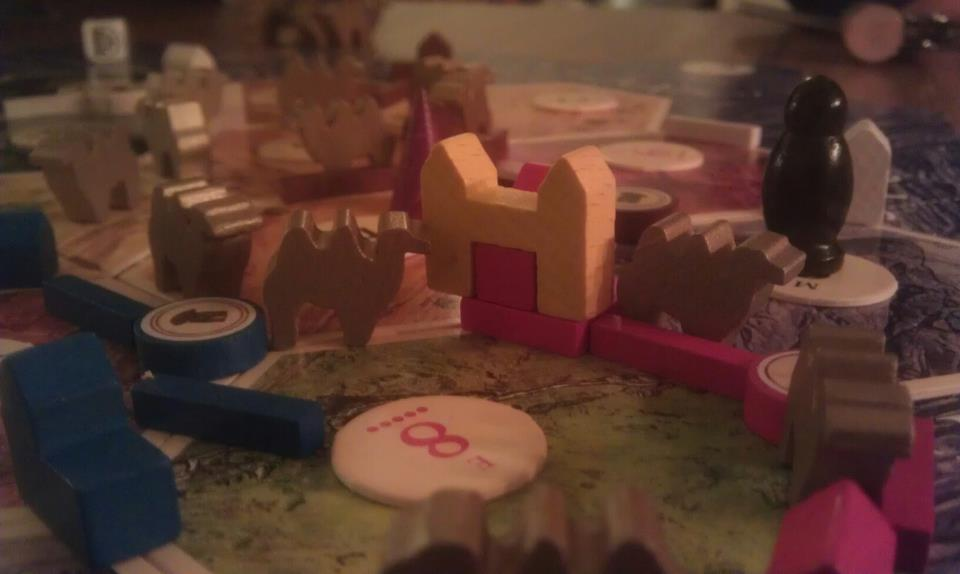
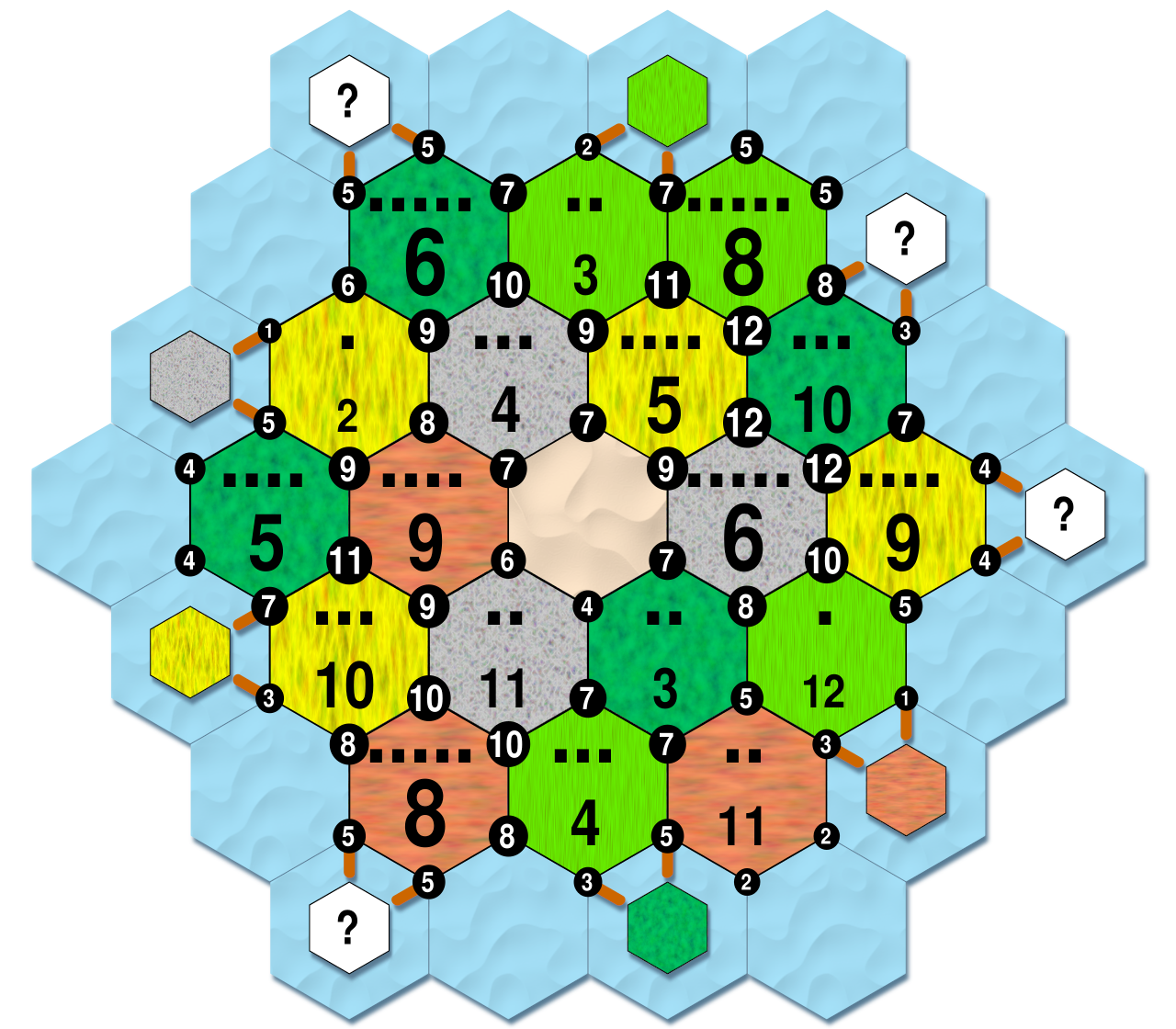
In Catan, players take on the roles of settlers building and developing holdings on the fictional island of Catan while trading and acquiring resources. The game board is composed of hexagonal tiles of different land types, laid out randomly at the start of each game; newer editions depict a fixed layout for beginners. Players build by spending resources (wool, grain, lumber, brick, ore) that correspond to specific land types: hills produce brick, forests lumber, mountains ore, fields grain, and pastures wool. On each turn, two six-sided dice are rolled to determine which hexes produce resources; settlements adjacent to a rolled hex yield one resource card, cities yield two. Rolling a 7 activates the robber token, which blocks production on a hex and allows the rolling player to steal a card from an opponent; players with eight or more cards must discard half. The goal is to reach ten victory points, earned through settlements, cities, longest road, largest army, and certain development cards.
Reader's Guide
Catan's significance lies in its role as a gateway game that popularized Eurogame mechanics—resource management, trading, and strategic building—outside Europe. Rebranded as simply Catan in 2015 for its 20th anniversary, the game has sold over 32 million copies and is published by multiple companies including Catan Studio and Filosofia. Its legacy includes inspiring numerous variants and historical scenarios, such as those based on the pyramids of Egypt and Alexander the Great's empire.
Did You Know?
- The game was originally called The Settlers of Catan before being rebranded as Catan in 2015.
- The robber token was changed from black to grey in the fourth edition, and the soldier development card was renamed a knight.
- The first expansion, Seafarers of Catan (1997), added ships and gold-producing hexes.
Origins & Design Philosophy
Klaus Teuber originally envisioned Catan as a sprawling exploration and development experience set in a new, untamed land. Between 1993 and 1995, he worked alongside Franckh-Kosmos Verlag to strip the concept down into the tighter, more accessible format that would become a landmark title. Mechanics that were cut during this refinement process did not simply vanish; they resurfaced in Teuber's subsequent games, Entdecker and Löwenherz. The first expansion, Catan: Seafarers, reintroduced the exploratory spirit of that original vision by sending players across sea hexes to an archipelago, and the combined 'New Shores' experience is often cited as the closest any release came to Teuber's initial ambitions. The result of that 1995 distillation was a game that balanced strategic depth with approachable rules, setting a template that would define the Eurogame genre for decades to come.
Core Gameplay Loop
At its heart, Catan asks players to settle a hexagonal island by building roads, settlements, and cities while managing five resource types—wool, grain, lumber, brick, and ore. Each turn, two six-sided dice determine which land tiles produce, and players collect resources based on the number of adjacent settlements or cities they control. The robber mechanic adds a layer of tension: rolling a 7 forces a player to relocate the robber, block a hex's production, and potentially steal a card from a rival, while any player holding eight or more resource cards must discard half. Beyond construction, players negotiate trades with one another or with the bank at fixed ratios, and can purchase development cards that grant everything from a free victory point to the ability to build two roads at once or command the largest army. The first player to accumulate ten victory points—earned through settlements, cities, longest road, and largest army—claims the island.
Global Impact & Commercial Legacy
When The Settlers of Catan hit German shelves in 1995, it carried a quiet but significant distinction: it became one of the first Eurogames to break through the European market and capture a worldwide audience. That initial spark ignited a commercial trajectory that, by 2020, had seen more than 32 million boxed copies sold across 40 languages. The title's publishing footprint expanded well beyond its original home at Franckh-Kosmos Verlag, with editions produced by Catan Studio, Filosofia, GP Inc., 999 Games, Káissa, and Devir, ensuring the game reached players on multiple continents. The game's cultural penetration was further reinforced by its mathematical richness; a 2015 study highlighted its potential as a classroom tool for exploring probability and resource allocation, while a 2020 analysis by the Board Game Analysis blog modeled the statistical balance of board layouts, finding that the recommended beginner configuration scored an impressively low 0.094 on a 0-to-1 imbalance scale.
Expansions & Series Evolution
Catan's base game, designed for three to four players, quickly outgrew its original scope. In 1996, a five-to-six-player extension arrived, adding extra components and a shared building phase that let players act outside their own turn, though trading was restricted during that window. The following year brought Seafarers of Catan, which introduced ships, sea hexes, gold-producing tiles, and archipelago exploration scenarios, fundamentally widening the strategic canvas. Cities and Knights of Catan followed in 1998, layering in card-game mechanics and new concepts that deepened the settlement-building experience. Together, these expansions transformed a single island strategy game into a sprawling franchise, each release building on the core loop of resource gathering, negotiation, and development while introducing fresh tactical dimensions. The series demonstrated that a well-designed base game could sustain years of creative expansion without losing its identity.
Common Misconceptions (Editorial)
1. Some people think Catan always used the name "Catan," but it was originally titled *The Settlers of Catan* and was rebranded as simply *Catan* in 2015. 2. A common belief is that the robber token has always been black or that the soldier card is named "soldier," but the robber was changed from black to grey in the fourth edition, and the development card was renamed to "knight."
Why It Matters (Editorial)
Catan endures because it helped popularize the Eurogame genre—focused on strategy and resource management over direct conflict—to a global audience, proving that thoughtful, non-combative board games could achieve mass appeal. Its randomized hexagonal board and trading mechanics keep each session fresh and social, which is why it remains a gateway game for new hobbyists and a staple for veterans decades after its debut.
Gallery
Frequently Asked Questions
Who designed Catan?
Catan was created by Klaus Teuber, a German game designer who developed the concept in the early 1990s before it reached shelves.
When and where was Catan first published?
The game debuted in 1995 in Germany through Franckh-Kosmos Verlag, doing business as the Kosmos imprint.
How many players can a standard Catan game support?
The boxed set is built for 3 to 4 players, though expansion components allow up to 6 people to take part in a single session.
What genre is Catan classified under?
It is a Eurogame centered on settlement building and resource trading across the island of Catan.
How commercially successful is Catan?
As of 2020, more than 32 million boxed copies had been sold worldwide, with the game available in 40 different languages.
More in Board Games 1-22
Spotted an error? Know more?
This is a living reference — every entry is fact-audited, and reader corrections feed straight into our audit queue. Suggest an edit · See this site's audit record