
Dominoes
Tile-based games with ancient Chinese roots and modern European evolution.

Carlos ZGZ from Paris, France · CC BY 2.0
Dominoes are a family of tile-based games played with rectangular pieces, each divided into two square ends marked with a number of spots or left blank. Originating in Song dynasty China and later appearing in mid-18th century France, dominoes have become a generic gaming device used for a variety of games, divination, and entertainment such as toppling.
- earliest_mention
- 13th century China (Song dynasty)
- modern_appearance
- Mid-18th century France
- traditional_set
- Double-six set with 28 tiles
- common_games
- Domino Whist, Matador, Muggins (All Fives), Texas 42, Chicken Foot, Concentration, Double Fives, Mexican Train
- materials
- Traditionally bone, ivory, ebony; modern sets use plastics
- name_origin
- Probably from resemblance to Venetian Carnival costume (black-hooded robe and white mask)
Lore & Background
An identifiable version of Chinese dominoes developed in the 12th or 13th century, with tiles functionally identical to playing cards. The traditional 32-piece Chinese set represented each possible face of two thrown dice and had no blank faces, though blank-faced Chinese dominoes were known in the 17th century. Modern dominoes first appeared in France during the mid-18th century, but they differ from Chinese dominoes in several respects, and there is no confirmed link between the two; European dominoes may have developed independently, or Italian missionaries may have brought the game to Europe, though there is no evidence of this. The name 'domino' is probably derived from resemblance to a carnival costume worn during the Venetian Carnival, often consisting of a black-hooded robe and a white mask. The double-one tile looks like the domino mask. From France, the game spread to Great Britain, Austria, southern Germany, and Italy. Early European rules described a simple block game; later variants included Domino à la Pêche (an early draw game). In England, the game was introduced by the late 1700s, purportedly by French prisoners-of-war.
Reader's Guide
Dominoes hold significance as a versatile gaming device, similar to playing cards or dice, enabling a wide range of games from simple blocking to complex scoring. The traditional double-six set (28 tiles) remains iconic, but extended sets (double-nine, double-12, double-15, double-18) accommodate more players. The game's history reflects a possible independent development in Europe, with no confirmed link to Chinese dominoes, despite earlier Chinese examples. Dominoes have also been used for divination in Chinese culture and the African diaspora. The materials used—from bone and ivory to modern plastics—show evolution in manufacturing. The most commonly played games include Domino Whist, Matador, and Muggins, with regional favorites like Fives and Threes in Britain and Texas 42 in the United States. The practice of domino toppling is another form of entertainment. The name's origin from Venetian Carnival costume adds a cultural layer, though there is no connection between the word 'domino' and the number 2 in any language.
Did You Know?
- The name 'domino' is probably derived from a Venetian Carnival costume consisting of a black-hooded robe and white mask.
- Dominoes have been used for divination, such as bone throwing in Chinese culture and in the African diaspora.
Origins: From Song Dynasty China to Eighteenth-Century France
The story of dominoes stretches back to thirteenth-century China, where the earliest written reference appears in Zhou Mi's text Former Events in Wulin. In Hangzhou during the reign of Emperor Xiaozong, street vendors reportedly sold pupai—gambling plaques or tiles—alongside dice, though scholars debate whether this term unambiguously denotes dominoes. A clearer description emerges two centuries later through Ming-era writer Lu Rong. The oldest known rulebook, the Manual of the Xuanhe Period, is attributed to Qu You, yet some researchers suspect it is a later fabrication.
Chinese dominoes evolved as a 32-tile set representing every possible outcome of rolling two six-sided dice, with no blank faces and a division into military and civil suits. The tiles were notably longer than their European counterparts. By the mid-eighteenth century, a distinct 28-tile form emerged in France, incorporating blank ends and a different combinatorial logic. Despite speculation that Italian missionaries might have carried the game westward, no documentary evidence confirms a direct transmission, leaving the European tradition as either an independent invention or an untraceable borrowing.
Craft and Material: The Physical Object of the Domino
From the earliest European workshops to today's factory floors, the physical construction of dominoes has been remarkably diverse. Traditional sets were carved from bone, mother of pearl, ivory, or dense hardwoods like ebony, with pips either inlaid or painted in contrasting black and white. Some premium sets layered the top half in pearl or ivory while the bottom half was ebony. Beyond these organic materials, artisans have shaped dominoes from marble, granite, soapstone, ash, oak, redwood, and cedar, as well as brass, pewter, ceramic clay, frosted glass, and crystal. These natural-material sets tend to be heavier and more expensive, giving players a substantial tactile experience.
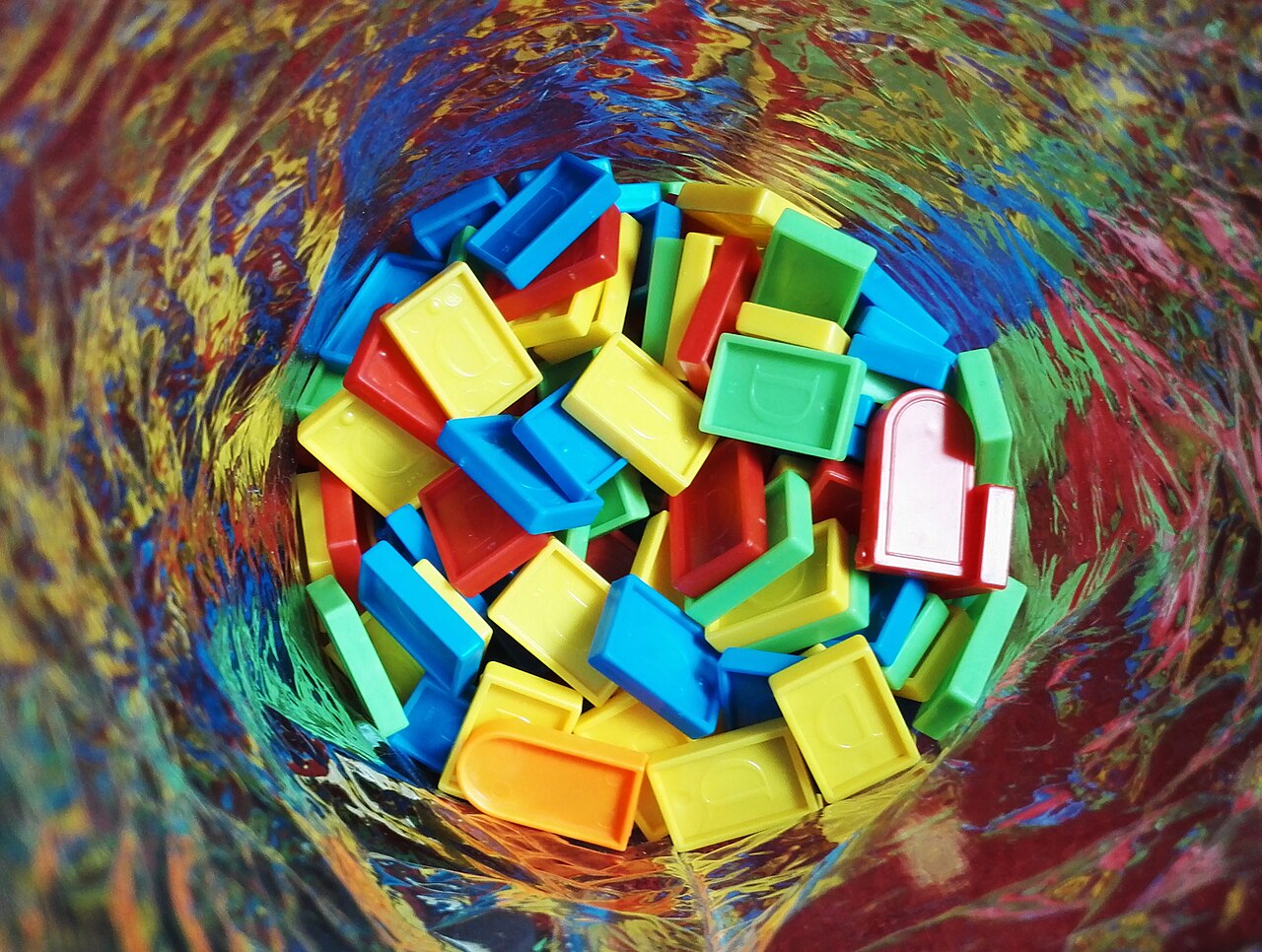
Modern commercial production has shifted largely to synthetic polymers—ABS plastic, polystyrene, Bakelite, and other phenolic resins—many of which mimic the warm appearance of ivory. Contemporary sets often assign a distinct color to each pip value, making it easier to spot matching ends at a glance. At the opposite end of the spectrum, card-stock dominoes offer a lightweight, compact, and budget-friendly alternative, though they are more vulnerable to drafts and minor disturbances. A few sets even incorporate a small metal spinner or pivot pin at the tile's center.
The Set as a Universal Game Platform
A standard European domino set contains exactly 28 unique tiles, one for every possible pairing of two ends ranging from zero to six spots. Because blank ends are included alongside the six pip values, seven distinct faces exist, yielding the 28 combinations of the double-six set. This modest count, however, becomes limiting when more than four players gather, prompting the creation of extended sets. Each step up adds three spots to the maximum end value: double-nine produces 55 tiles, double-12 yields 91, double-15 reaches 136, and double-18 tops out at 190 tiles—the practical ceiling. In these larger sets, counting individual pips grows cumbersome, so many manufacturers substitute Arabic numerals for clarity.
The 28-tile double-six set functions as a generic gaming platform, much like a deck of cards or a pair of dice, supporting an enormous variety of rulesets. Among the most widely played are Domino Whist, Matador, and Muggins (also called All Fives). Other beloved formats include Texas 42, Chicken Foot, Concentration, Double Fives, and Mexican Train. In Britain, the pub and league staple is Fives and Threes, a game that has become deeply embedded in local social culture.
Name, Divination, and the Art of Toppling
Beyond the table, dominoes have woven themselves into a surprisingly wide cultural tapestry. The very name likely traces back to the Venetian Carnival, where participants wore a black-hooded robe paired with a white mask; the double-one tile, with its single centered pip on each half, visually echoes that iconic domino mask. Despite the later coinage of "polyomino" as a mathematical generalization, the word "domino" carries no etymological link to the number two in any known language.
In several traditions, dominoes have served purposes well beyond recreation. In Chinese culture, the practice of bone throwing used tiles as instruments of divination, a custom that also traveled through the African diaspora. Meanwhile, the simple act of arranging tiles in a line and toppling them—domino toppling—has become a standalone form of entertainment that requires no rules, scoring, or opponents whatsoever. The backs of tiles in any set are deliberately made indistinguishable, whether left plain or decorated with a shared motif, ensuring that the face-up information remains the sole source of strategy and surprise in every game played.
Common Misconceptions (Editorial)
- A common misconception is that European dominoes are directly descended from Chinese dominoes. However, the facts state that while Chinese dominoes existed from the 12th or 13th century, modern dominoes appeared in mid-18th century France with no confirmed link, and may have developed independently. - Some people think the name "domino" refers to the game piece itself first, but it probably derives from a Venetian Carnival costume (a black-hooded robe and white mask), not from the tiles originally.
Why It Matters (Editorial)
Dominoes endure because they bridge simple physical play—arranging and toppling tiles—with strategic depth in games like Texas 42 or Muggins. Their adaptability across cultures, from Chinese divination to European parlor games, shows how a basic set of marked rectangles can become a universal tool for entertainment, competition, and even fortune-telling.
Gallery




Frequently Asked Questions
What does a standard dominoes set look like?
A traditional set contains 28 rectangular tiles, each split down the middle into two square halves that carry a number of pips or are left blank. This double-six layout is the baseline from which most domino games are built.
Where did dominoes come from?
The earliest known references place domino tiles in 13th-century Song dynasty China, but the game didn't reach European players until the mid-1700s in France. Over the following centuries it spread across the continent and became a generic gaming platform rather than a single fixed game.
What games can you actually play with dominoes?
Beyond simple matching-and-dropping, the tiles underpin a wide range of named games such as Muggins (All Fives), Texas 42, Mexican Train, Chicken Foot, and Double Fives. The same pieces are also used for divination, toppling, and other casual entertainment.
What material are dominoes traditionally made from?
Historical sets were carved from bone, ivory, and ebony, giving the tiles a dense, polished feel. Most modern sets have moved to molded plastics for cost and durability, though the two-ended rectangular shape has stayed the same.
Why is the game called 'dominoes'?
The name most likely references the black-hooded robes paired with white masks worn during the Venetian Carnival, which visually echo the dark-and-light split of each tile. This etymology links the game's label to a European costume tradition rather than to its Chinese tile origins.
More in Board Games 1-22
Spotted an error? Know more?
This is a living reference — every entry is fact-audited, and reader corrections feed straight into our audit queue. Suggest an edit · See this site's audit record