Draughts
A strategy board game with mandatory captures and multiple international variants.

White, John G. (John Griswold), 1845-1928 · Public domain
Draughts, also known as checkers in North American English, is a group of strategy board games for two players involving forward movements of uniform game pieces and mandatory captures by jumping over opponent pieces. Developed from alquerque, the game is played on a checkered board, with the term 'draughts' deriving from the verb 'to draw' or 'to move.' The most popular forms in Anglophone countries include American checkers (English draughts) on an 8×8 board, as well as international draughts on a 10×10 board, among many other variants.
- Also known as
- Checkers
- Origin
- Developed from alquerque, likely between the 13th and 16th centuries
- Board sizes
- 8×8, 10×10, 12×12 (depending on variant)
- Common variants
- American checkers, Russian draughts, Turkish draughts, Armenian draughts, international draughts, Canadian checkers, Malaysian/Singaporean checkers
Lore & Background
The ancestry of draughts remains uncertain, with popular accounts tracing it to ancient Mesopotamia and Egypt, though archaeological finds such as the Game of Ur (circa 3000 BCE) show little resemblance to modern draughts. Egyptian checker-patterned boards exist in the British Museum, and carvings at the temple of Kurna have been attributed to alquerque, Nine Men's Morris, or Zamma, with Coptic crosses casting doubt on their claimed antiquity. The Ancient Greeks and Romans played capture games like Petteia and Latrunculi, which share some similarity.
Reader's Guide
A more likely ancestor is alquerque, played on a 5×5 grid and mentioned by the 10th-century Arab scholar Abu al-Faraj al-Isfahani. Whether forced captures or promotion existed in alquerque remains unclear from the manuscript. Sometime between the 13th and 16th centuries, draughts developed as an alquerque game that migrated to chess boards, leading to English draughts or checkers, with diagonal-only movement forcing progress. The game is played on dark squares only, with men moving forward and kings gaining additional powers. In American checkers, a king's only advantage is moving and capturing backwards; in international draughts, kings are flying kings that can move any number of squares. The game is also played online via apps.
Did You Know?
- The term 'draughts' derives from the verb 'to draw' or 'to move,' while 'checkers' comes from the checkered board.
- In most non-English languages, checkers is called dame, dames, or damas, referring to ladies, and promoted kings are called dames or ladies.
The Mystery of Ancient Origins
The true ancestry of draughts remains one of board gaming's most debated questions. While popular narratives often push the game's roots back thousands of years into Mesopotamia and Egypt, scholars urge caution. Excavations at Ur, in modern-day Iraq, uncovered game boards dating to roughly 3000 BCE, yet the Game of Ur itself—using seven markers and three tetrahedral dice per player—functioned as a race game closer in spirit to backgammon than to the jumping-and-capturing mechanics that define draughts. Egyptian evidence presents a similar puzzle. The British Museum holds checker-patterned boards recovered from burial chambers, and records indicate the pharaoh Hatshepsut played on such surfaces. Carvings at the temple of Kurna, sometimes cited as 1400 BC depictions of checkers, have alternatively been identified as Alquerque, Nine Men's Morris, or Zamma. Tellingly, some of these diagrams bear Coptic crosses, symbols that would not have existed in the second millennium BCE, suggesting the carvings are far younger than traditionally claimed. The Greeks and Romans did play capture games—Petteia and Latrunculi—that share certain structural echoes with draughts, and the modern game is understood to have evolved from alquerque.
A Name on Every Continent
The game goes by different names depending on where you play, and those names reveal a fascinating linguistic web. In North American English it is "checkers," a straightforward reference to the checkered board on which pieces travel. British English prefers "draughts," a word rooted in the old verb meaning "to draw" or "to move." Across most non-English-speaking cultures, however, the game carries a title meaning "ladies"—dame, dames, damas, or close variants. The promoted pieces are likewise called dames or ladies, and in languages like Greek, the same word (ντάμα, or "dama") also names the queen in chess. This shared terminology blurs the boundary between two of the world's most beloved strategy games. The pieces themselves go by many names: men, stones, or peón in Spanish-speaking regions. Board sizes vary widely. American, Russian, Turkish, and Armenian draughts all use the familiar 8×8 grid, while international draughts expands to 10×10 and is the most widely played variant globally. At the other extreme, Canadian checkers and the Malaysian/Singaporean game known locally as dam stretch the field to 12×12 squares.
The Dance of Jumps and Crowns
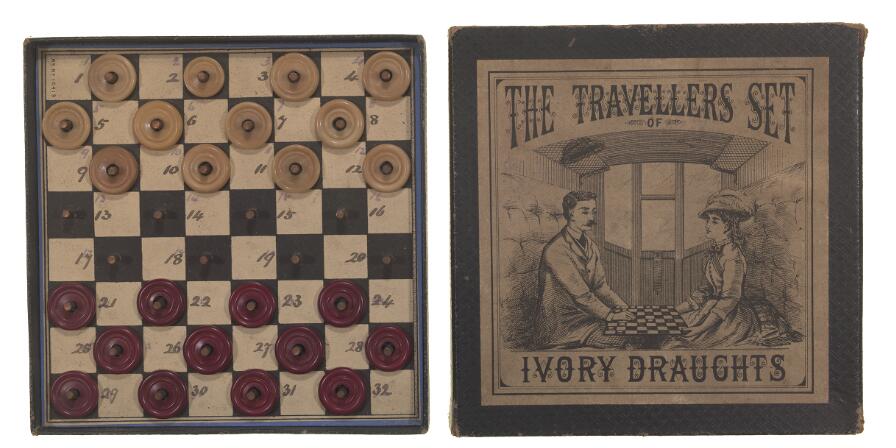
At its core, draughts is a game of diagonal travel and forced confrontation. Two opponents sit across the board—one commanding dark pieces, the other light—with the darker side always moving first. Every piece advances one square diagonally along the dark squares, and initially all movement is strictly forward. The defining tension is capture: when an opponent's piece sits in the diagonal square ahead and the space beyond it is empty, the jump is obligatory under most official rules. Failing to take a mandatory capture invites a penalty called a muffin, where the opponent may simply remove the piece that should have been jumped. A single turn can chain multiple jumps, and those jumps need not follow one diagonal; a piece may zigzag, changing direction mid-sequence to sweep up several enemies at once. When a man reaches the farthest row, it is crowned and becomes a king. In international draughts, the king earns the extraordinary status of a "flying king," gliding any number of squares forward or backward and capturing an enemy man at any distance by leaping to any vacant square just past it. In American checkers, the king's only upgrade is the ability to move and capture in reverse.
Solved, Yet Still Played
In 2007, a team of Canadian computer scientists led by Jonathan Schaeffer achieved a milestone that no human mind could have matched: they weakly solved American checkers. Their work demonstrated that from the standard starting position, if both players execute perfect play, the game will inevitably end in a draw. No first-move advantage, no hidden tactical trap—just a perfectly balanced outcome baked into the mathematics of the 8×8 board. One might assume such a result would render the game a curiosity for computer-science papers rather than a living pastime. Yet draughts and its variants continue to thrive. International draughts, with its larger 10×10 board and flying kings, is widely played in many countries around the world. And the game has found a second life in the digital age: free applications available on both the Apple App Store and the Google Play Store put a full checkers match within reach of anyone with a smartphone, keeping the rhythm of diagonal jumps and forced captures alive for new generations of players.
Common Misconceptions (Editorial)
1. Some believe draughts originated in ancient Egypt or Mesopotamia based on board games like the Game of Ur, but the facts show that while Egyptian checker-patterned boards exist, the specific ancestry of modern draughts remains uncertain and such claims are complicated by later carvings (e.g., Coptic crosses) that cast doubt on their claimed antiquity. 2. It is often assumed that "checkers" and "draughts" are distinct games, but the facts confirm they are the same game under different regional names, with "draughts" as the original term and "checkers" used in North American English. 3. Many think kings in non-English versions are called "kings," but in most non-English languages, promoted pieces are called "dames" or "ladies," not kings.
Why It Matters (Editorial)
Draughts endures because it distills strategic depth into elegantly simple rules—mandatory jumping and forward-only movement—making it instantly accessible yet endlessly complex for serious players. Its spread from medieval Europe to global variants like international and Turkish draughts shows how a single game can adapt to different cultures while maintaining its core tension between offense and defense, proving that timeless puzzles need not be complicated to fascinate.
Gallery
Frequently Asked Questions
What is Draughts?
Draughts is a two-player strategy board game in which each side advances uniform pieces diagonally across a checkered grid and must capture opponent pieces by jumping over them. The name traces back to the old English verb meaning 'to draw' or 'to move.' The game evolved from the much older medieval game alquerque over several centuries.
What's the difference between Draughts and Checkers?
They are the same family of games — 'draughts' is the standard term in British and most other non-North American English, while 'checkers' is the everyday name in American English. The rules, pieces, and board are identical; only the regional vocabulary changes.
How does a game of Draughts actually work?
Players alternate moving their pieces diagonally forward on dark squares, and any available jump over an opponent's piece is mandatory rather than optional. A regular piece that reaches the far row is promoted to a king, gaining the ability to move and capture in both directions. The game ends when one player has captured all of the opponent's pieces or left them with no legal moves.
What is International Draughts and how is it different?
International Draughts is the 10×10 variant played with 20 pieces per side, featuring multi-jump sequences and a 'longest capture' rule that makes it far more complex than the 8×8 American version. It is governed by the World Draughts Federation and remains the dominant form in much of Europe and parts of Africa.
More in Board Games 1-22
Spotted an error? Know more?
This is a living reference — every entry is fact-audited, and reader corrections feed straight into our audit queue. Suggest an edit · See this site's audit record