Backgammon
Two-player board game of contrary movement with dice and counters.

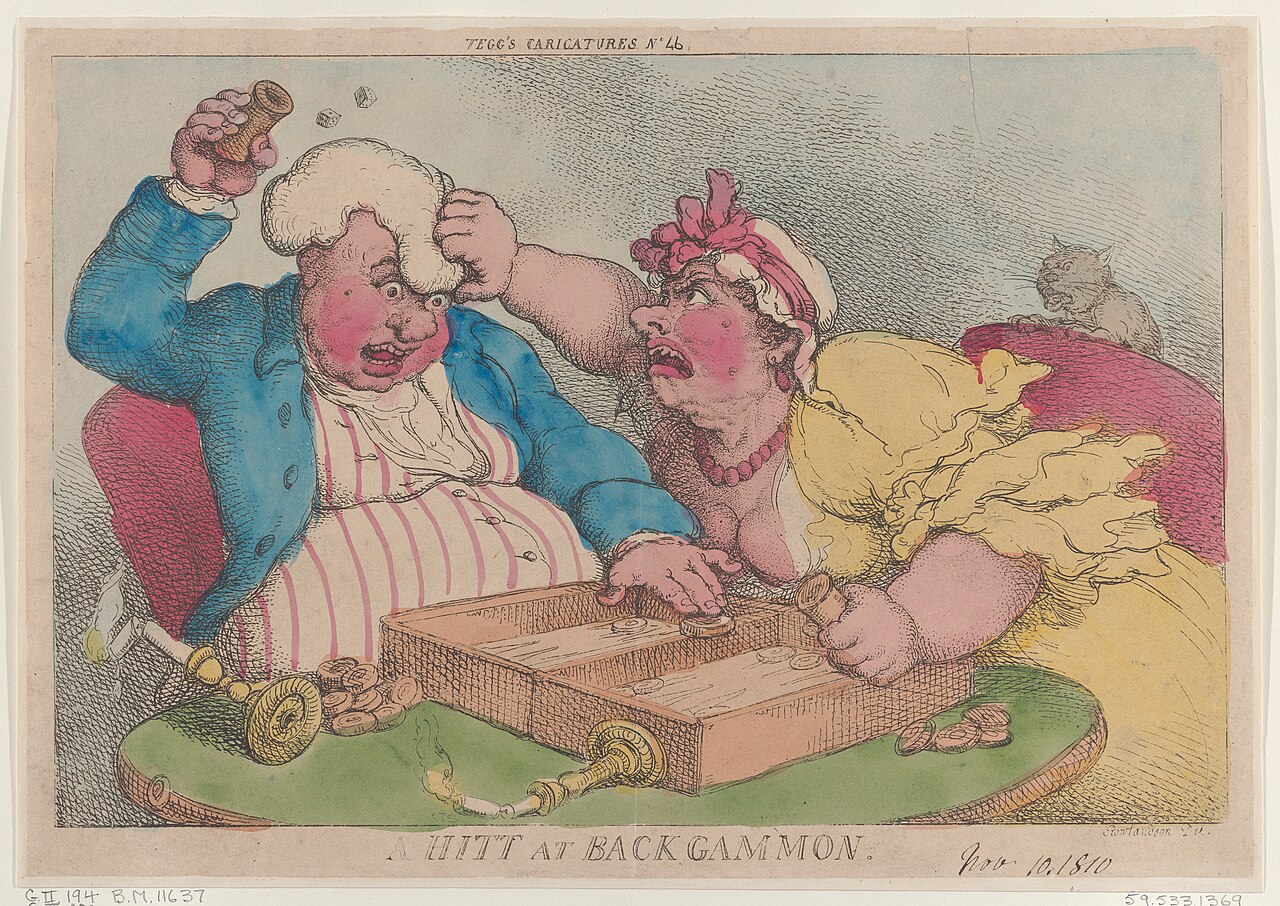
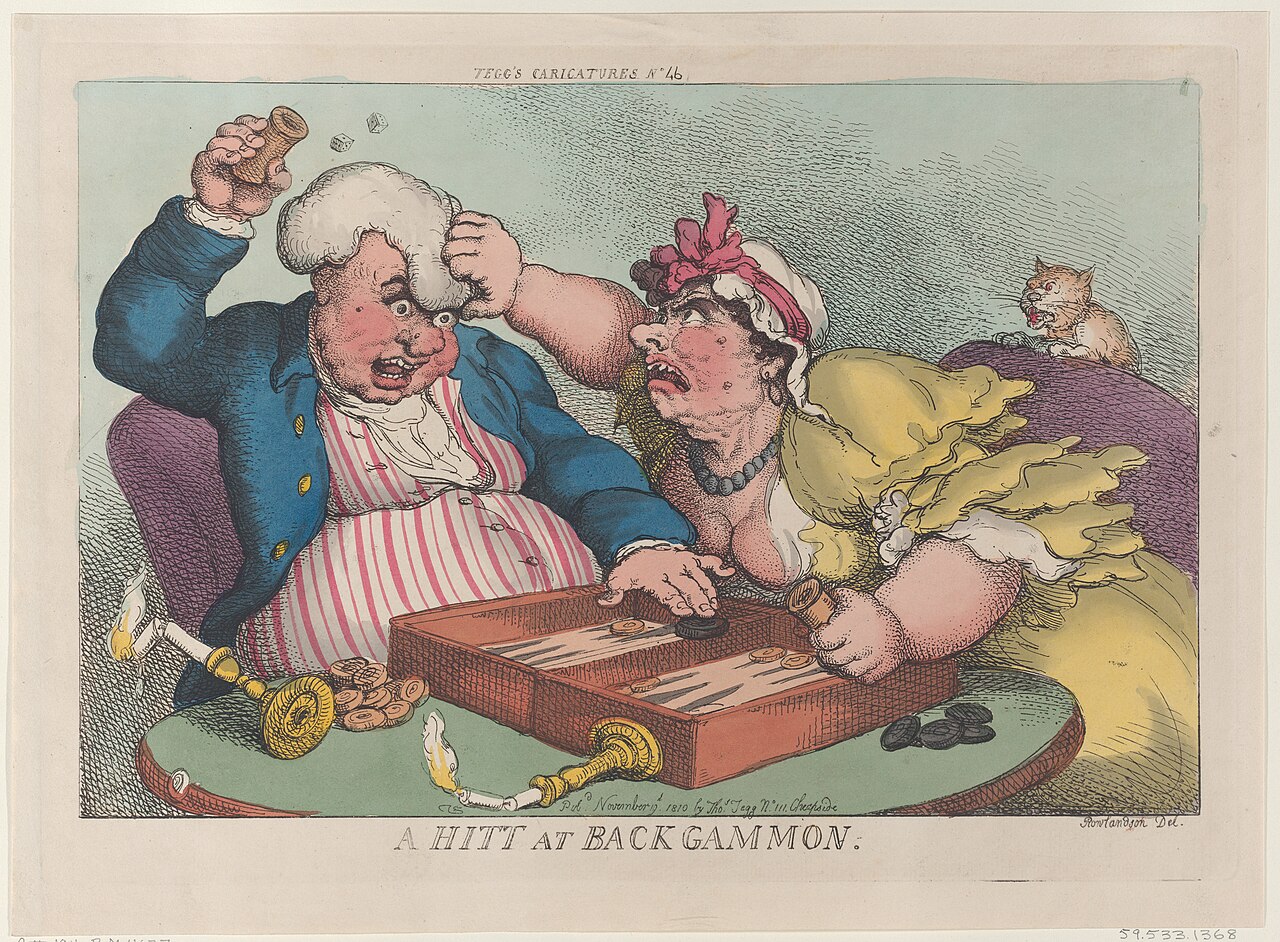
Thomas Rowlandson · CC0
Backgammon is a two-player board game played with counters and dice on tables boards. It is the most widespread Western member of the large family of tables games, whose ancestors date back at least 1,600 years. The earliest record of backgammon itself dates to 17th-century England, where it emerged as a variant of the game of Irish in the early 17th century.
- Predecessor
- Early 17th-century variant of the game of Irish
Lore & Background
Backgammon's immediate predecessor was a 17th-century variant of the game of Irish, not the 16th-century game itself. Irish was the Anglo-Scottish equivalent of the French Toutes Tables and Spanish Todas Tablas. Irish had been popular at the Scottish court of James IV and was considered 'the more serious and solid game' when the variant that became known as Backgammon began to emerge in the first half of the 17th century.
Reader's Guide
Backgammon involves a combination of strategy and luck from rolling of the dice. While the dice may determine the outcome of a single game, the better player will accumulate the better record over a series of many games. With each roll of the dice, players must choose from numerous options for moving their pieces and anticipate possible counter-moves by the opponent. The optional use of a doubling cube allows players to raise the stakes during the game. By the 19th century, backgammon had spread to Europe, where it rapidly superseded other tables games like Trictrac in popularity, and also to America, where the doubling cube was introduced. The early form of backgammon was very similar to its predecessor, Irish, but lacked a doubling die and a bar on the board. By no later than 1850, the rules of play had changed to those used today, with tables boards now made with a bar in the centre.
Did You Know?
- The word 'backgammon' is most likely derived from 'back' and Middle English 'gamen', meaning 'game' or 'play'.
- The achievement of bearing off all pieces while the opponent is still a long way behind results in a triple win known as a backgammon, named after the game itself.
- The doubling cube was introduced in the 1920s in New York, though backgammon had already been known in Europe and America well before the 19th century.
Ancient Roots and the Long Lineage of Tables Games
The story of backgammon stretches back nearly five millennia. Archaeologists in Iran uncovered a game set from the Jiroft culture, the oldest known board-game equipment, featuring a dumbbell-shaped board, counters, and dice. Though its exact rules remain unknown, scholars such as Irving Finkel have attempted a reconstruction. The Royal Game of Ur, dating to around 2600 BC, stands as the oldest game with surviving rules and may serve as an ancestor to modern tables games; it employed tetrahedral dice. Between the 10th and 7th centuries BC, additional board games surfaced across Iraq, Syria, Egypt, and western Iran. In the Sasanian Empire, the Persian game of nard or nardšir emerged between the 3rd and 6th centuries AD, with one text crediting Ardashir I and another attributing its invention to the vizier Bozorgmehr Bokhtagan. These ancient games share equipment and layout with backgammon, which has led to the mistaken assumption that the game itself is far older than it actually is.
Roman Tabula and the Byzantine Bridge
The earliest clearly identifiable tables game we can name is Tabula, described in an epigram by Byzantine Emperor Zeno around AD 476–491. Its structure mirrors modern backgammon in many respects: a board with 24 points split across two sides, 15 counters per player, and the goal of bearing off first. Yet key differences set it apart—three cubical dice instead of two, no bar, no doubling die, and all pieces starting off the board. Modern backgammon retains Tabula's rules for hitting a blot and for bearing off, while its re-entry rules mirror Tabula's initial entry rules. Tabula itself is believed to descend from the Roman ludus duodecim scriptorum, the Game of Twelve Lines, which used three rows of 12 points and three dice. The earliest known literary mention of that Roman game appears in Ovid's Ars Amatoria, composed between 1 BC and 8 AD. In Greece, the name Tavli survives today for tables games still played in town squares and cafés.
Medieval Europe and the Game's Cultural Footprint
Tables games arrived in France during the 11th century and quickly became a favorite pastime among gamblers, drawing enough concern that King Louis IX issued a decree in 1254 forbidding his court officials and subjects from playing. The games had already reached Germany by the 12th century and Iceland by the 13th. In Spain, the Toledo School of Translators produced the Libro de los Juegos in 1283, a manuscript under Alfonso X that laid out rules for multiple dice and table games alongside chess. By the 17th century, tables games had spread as far as Sweden; a wooden board and counters were even recovered from the wreck of the warship Vasa, found among the personal belongings of the ship's officers. The cultural presence of these games in European art is striking. Painters such as van Ostade, Jan Steen, Hieronymus Bosch, and Bruegel depicted them in their works, and Caravaggio's Cardsharps remains one of the most famous surviving images of the era.
From Irish to Backgammon — Mechanics, Strategy, and the Name
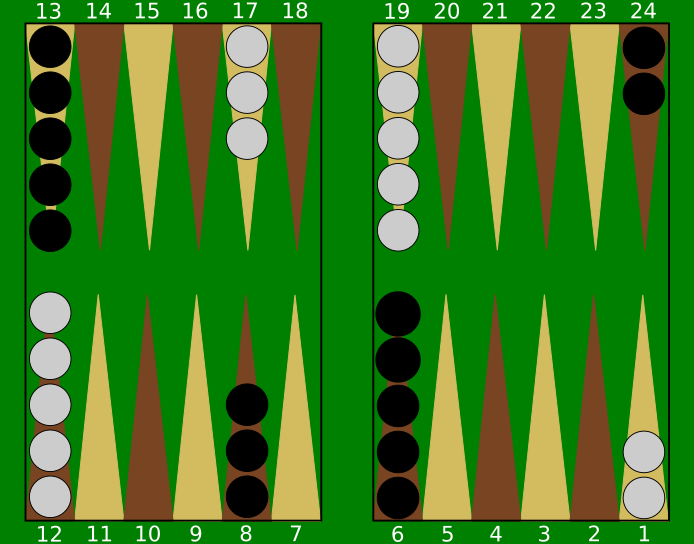
Backgammon's direct predecessor was the 16th-century Anglo-Scottish game of Irish, the local equivalent of French Toutes Tables and Spanish Todas Tablas. Irish was popular at the Scottish court of James IV and regarded as the more serious and solid game. The variant that became backgammon began emerging in the first half of the 17th century, with the earliest specific reference appearing in a 1647 letter. In the game itself, two players each command 15 pieces—traditionally called men, though increasingly checkers in the United States—moving them along 24 points according to the roll of two dice in contrary directions. The objective is to bear off all pieces first; achieving this while the opponent lags far behind produces a triple win called a backgammon, which gives the game its name. The blend of dice-driven luck and strategic decision-making means that while a single roll can decide one game, the stronger player prevails over a series. The optional doubling cube, introduced in America, lets players raise the stakes mid-game.
Common Misconceptions (Editorial)
Some people believe that backgammon dates back thousands of years in its current form, but the earliest record of the game itself is from 17th-century England. Another common misconception is that backgammon evolved directly from the 16th-century game of Irish; in fact, its immediate predecessor was a variant of Irish that emerged in the early 17th century, not the earlier version of the game.
Why It Matters (Editorial)
Backgammon endures as one of the few classic board games that balances skill, strategy, and chance, making each match unpredictable yet deeply competitive. Its long evolution from ancient tables games through royal courts in Scotland and England reflects a rich cultural heritage, while the late addition of the doubling cube shows its capacity for innovation, keeping it relevant across centuries.
Gallery
Frequently Asked Questions
Who is Backgammon?
Backgammon is a two-player board game of contrary movement played with dice and counters on a tables board. It stands as the most widely played Western representative of the broader tables game family.
What are Backgammon's powers/role?
Players take turns rolling dice to advance their counters in opposite directions around the board, creating a contest where strategic positioning meets the randomness of each roll. The contrary-movement structure means both sides are racing in different directions simultaneously.
How does Backgammon's story begin?
The earliest documented record of Backgammon comes from 17th-century England, where it took shape as a variant of the older game called Irish. Its broader lineage within the tables game family reaches back at least 1,600 years.
Why is Backgammon important?
As the most widespread Western tables game, Backgammon carries forward a tradition of dice-and-counter gameplay stretching over a millennium and a half. Its lasting popularity stems from the tight balance between strategic decision-making and the uncertainty of each dice roll.
What is Backgammon's predecessor?
Backgammon originated in the early 17th century as a variant of a game known as Irish, played in England. This places it squarely within the ancient family of tables games whose ancestors date to at least 1,600 years ago.
More in Board Games 1-22
Spotted an error? Know more?
This is a living reference — every entry is fact-audited, and reader corrections feed straight into our audit queue. Suggest an edit · See this site's audit record